Selected work
Data analytics
How much of the world’s work is exposed to AI?
A study of generative AI and the global labour market. I rebuilt it after my own headline claim failed re-testing.
Two builds · tap to compare
Final project
Refined rebuild
Submitted · Wilmington College · May 2025
Predicting automation risk with supervised learning
I cleaned and merged four public labour datasets into an occupation-level risk model, then sorted roles into Low, Medium and High tiers. I submitted it with a 78.54% XGBoost accuracy.
78.54%
Reported model accuracy
4
Public datasets merged
3
Risk tiers classified
Findings
Exposure is not replacement
The best current global benchmark does not show AI taking most jobs. It shows which tasks could change first, and those pressure points fall unevenly.
34% / 11%
High-income economies versus low-income economies.
28% / 21%
Women’s employment versus men’s employment worldwide.
20 of 29
Clerical support occupations sit in the top two gradients.
13
Occupations in the highest gradient, led by data entry clerks.

ILO-NASK 2025 exposure gradients across 427 coded ISCO-08 occupations.
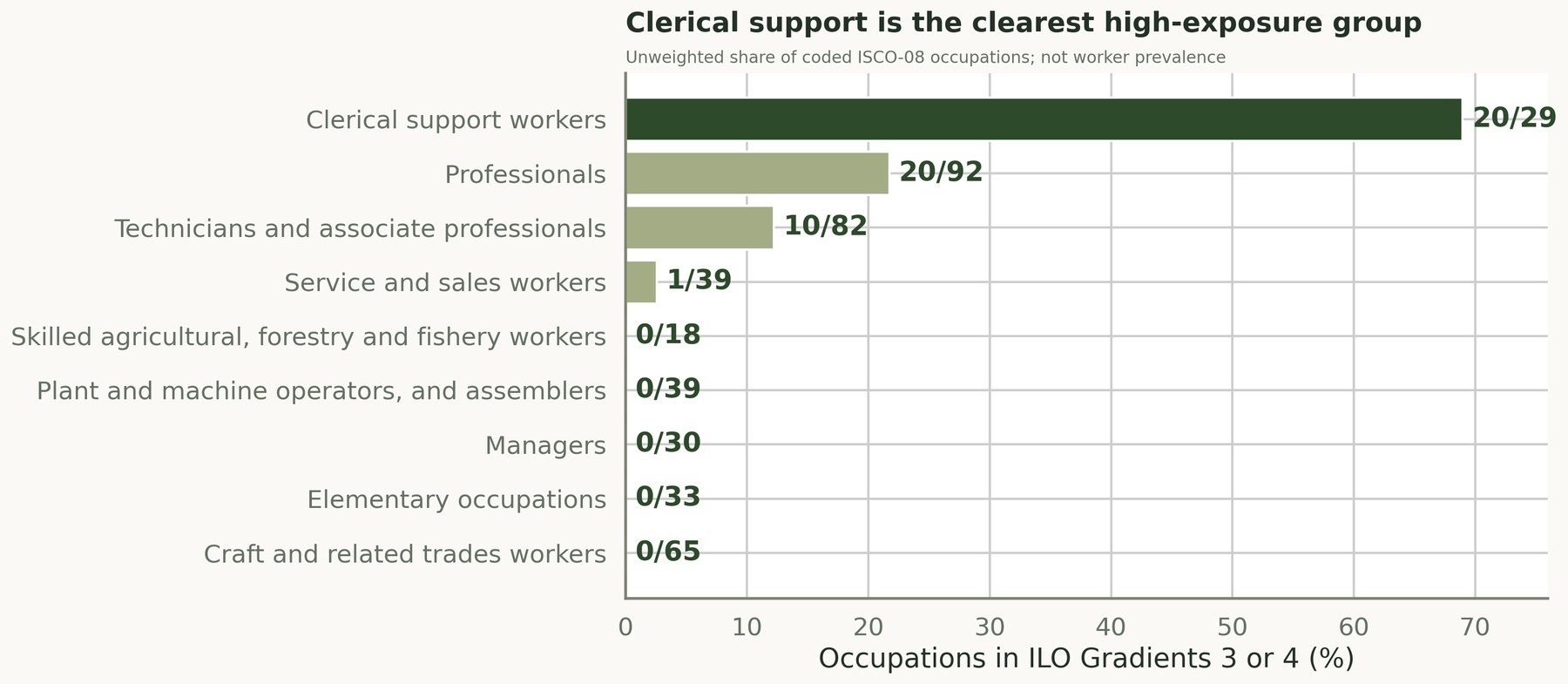
Higher-exposure share by major occupation group. Clerical support is the clear outlier.

Exposure by income group. Adoption capacity drives the gap more than task content.
The correction
I could not reproduce my own headline number
I re-ran the pipeline under honest validation and the 78.54% did not hold. My strongest defensible model reached 67.5% test accuracy and a 0.556 macro F1, against a majority-class baseline of 62.6%. At this resolution it performed close to guessing the largest class.
Submitted · reported as 78.54%

Re-tested · 67.5% against a 62.6% baseline

I retired the classifier instead of dressing it up. The argument now rests on measurement anyone can check: the ILO’s task-level index, with IMF and WEF alongside as separate measures. I never average them into one score.
Everything, downloadable
Read the work, not just the summary

The most exposed occupations worldwide, scored on task-level automation potential.
What this study does not claim
Exposure is not displacement
24% exposed means AI could perform or assist some current tasks. It is not a forecast that those jobs disappear.
The measures are not interchangeable
ILO 24%, IMF 40% and WEF 22% count different things. They are shown side by side, never averaged into one score.
WEF churn is not AI alone
170M created and 92M displaced covers all macrotrends employers cited, not generative AI on its own.
A static early-2025 estimate
Real adoption depends on cost, infrastructure, skills, regulation and workplace decisions the index cannot see.
Not suitable for hiring, dismissal or individual career decisions.

Exposure by sex, reflecting occupational segregation in clerical and administrative work.
Controlling sources
ILO-NASK Working Paper 140 (2025) as the controlling index · IMF Gen-AI and the Future of Work (2024) for definition sensitivity · WEF Future of Jobs (2025) for employer outlook · ILO gender brief (2026) using harmonised microdata from 84 countries.
Back to desktop